
Overview
A fast-growing fintech startup processing over $200M in annual transactions was drowning in compliance overhead. Every month, their small operations team spent the better part of a week manually pulling data, cross-referencing ledgers, and formatting reports for regulatory submissions — a process that was error-prone, exhausting, and entirely disconnected from their growth ambitions.
They came to Pyrotrix with a clear mandate: fix the compliance reporting problem so their team could focus on building product, not pushing spreadsheets.
Client snapshot
| Category | Details |
|---|---|
| Client | Confidential Fintech Company |
| Industry | Fintech — B2B payments processing |
| Company size | 45 employees, Series A |
| Engagement type | Custom automation build |
| Timeline | 8 weeks from kickoff to live |
The problem
The company was subject to quarterly reporting obligations under financial services regulations — a requirement that grew more complex as transaction volumes and product lines expanded.
By the time Pyrotrix was engaged, their compliance workflow looked like this:
- Operations team manually exported raw data from 4 separate internal systems
- Data was consolidated manually into a spreadsheet containing 60+ tabs
- A compliance consultant reviewed the output over 2–3 days
- Reports were formatted manually for regulator submission
- Any revision request forced the process to restart from scratch
Total time cost per reporting cycle: 40–55 hours.
At their operational cost structure, the company was spending over $18,000 in labor per quarter on compliance preparation alone.
The bigger concern was risk. A single reporting inconsistency could trigger a regulatory audit.
“We had a 10-person ops team doing the work of a compliance department. It was unsustainable.”
Why it was complex
This was not simply a reporting automation problem. The core issue was fragmented internal data infrastructure. Pyrotrix identified three major architectural challenges:
1. Schema fragmentation
Transaction records, account systems, and fee structures all used different data schemas and inconsistent identifiers.
2. Regulatory formatting constraints
Regulatory submission systems enforced rigid validation requirements around field naming, date formatting, decimal precision, and report hierarchy. Even minor inconsistencies caused rejection.
3. Audit trail requirements
Every figure inside a report had to map back to a traceable source record with timestamps and verification history.
No off-the-shelf compliance platform could satisfy all three requirements for the workflow. A custom-built system became the only viable option.
The Pyrotrix solution
Pyrotrix designed a three-layer compliance automation architecture.
1. Unified data layer
A centralized ETL pipeline was developed to pull and normalize data from all four source systems. The pipeline:
- extracted data automatically on schedules
- standardized field mappings
- reconciled unmatched records
- created a single source of truth
This eliminated manual spreadsheet consolidation entirely.
2. Automated report generation engine
Pyrotrix built a configurable reporting engine capable of generating regulator-ready reports instantly. The engine handled formatting rules, field validation, decimal normalization, date transformations, and report parameterization. Reports could be generated by selecting reporting type, reporting window, and entity scope — with no code changes required.
3. Compliance operations dashboard
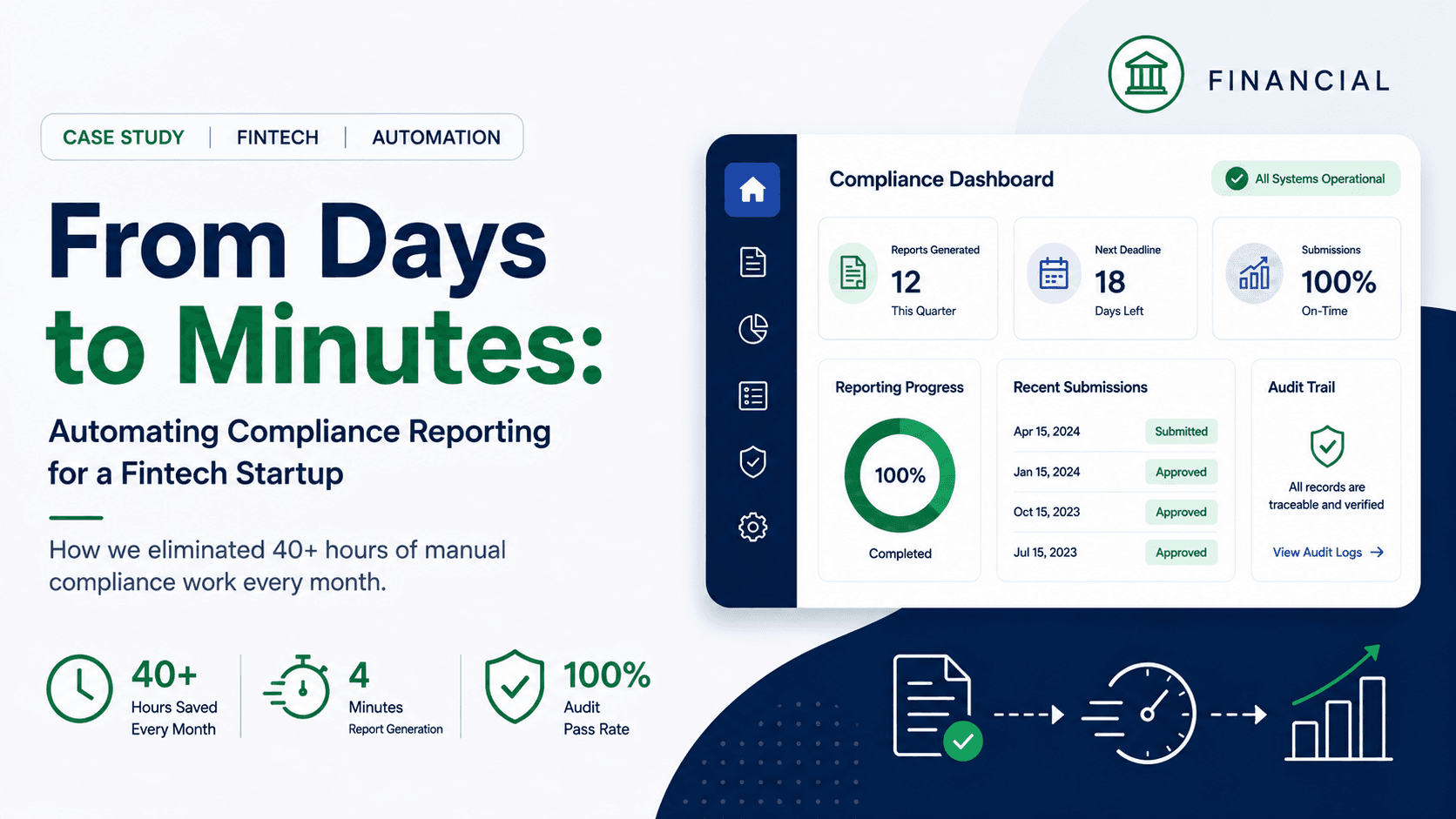
A self-service dashboard allowed compliance teams to generate reports instantly, preview submissions, review audit logs, track submission history, and monitor reporting deadlines. The dashboard also included compliance status indicators and automated alerts for upcoming deadlines.
Architecture overview
High-level view of the unified data, reporting, and operations layers delivered for this engagement.
Technology stack
| Component | Technology |
|---|---|
| Backend | Python |
| Workflow orchestration | Apache Airflow |
| Database | PostgreSQL |
| Frontend | React |
| Infrastructure | AWS |
| Security | SOC 2 aligned architecture |
The results
The platform went live in week 8. The first full compliance report was generated and submitted in under 20 minutes — compared to the previous 3-day process.
Impact metrics
- 97% reduction in reporting time
- $72,000+ annual operational savings
- Zero reporting errors across first six submissions
Six months after launch:
- Every regulatory report passed on first review
- External consulting dependency reduced by 60%
- Operations teams no longer managed reporting manually
- Compliance preparation shifted from reactive to proactive
“Pyrotrix did not just automate a task — they gave us our team back.”
Key takeaway
Compliance reporting becomes a major scalability bottleneck for fintech companies long before leadership realizes it. Pyrotrix approached the problem by fixing the underlying data architecture first — not simply accelerating broken workflows.
The result was:
- lower operational overhead
- improved audit readiness
- scalable compliance infrastructure
- dramatically reduced reporting risk
The system now scales with the business without requiring proportional headcount growth.