
Overview
A rapidly growing telemedicine platform connecting patients with licensed physicians across multiple states began experiencing infrastructure failures under production load.
Originally built for approximately 10,000 concurrent users, the system was suddenly expected to support hundreds of thousands of patients following rapid growth and new insurance partnerships.
A major insurance rollout deadline forced immediate action. Pyrotrix was brought in to redesign the platform architecture without disrupting active users or violating healthcare compliance requirements.
Client snapshot
| Category | Details |
|---|---|
| Client | Confidential Healthcare Platform |
| Industry | Telemedicine / Digital Health |
| Company size | 120 employees, Series B |
| Engagement type | Cloud architecture redesign |
| Timeline | 14 weeks |
The problem
The platform’s infrastructure relied on a monolithic application deployed on fixed-capacity servers. As traffic increased, system reliability deteriorated rapidly.
Major operational failures included:
- appointment booking pages taking 12–18 seconds to load
- consultation sessions disconnecting under peak traffic
- database timeouts causing failed prescription submissions
- manual scaling interventions during traffic spikes
- full application restarts required for deployments
The company had already breached its SLA uptime targets twice in one quarter. Another outage risked triggering contractual penalties from insurance partners.
“Every new user we added became a new infrastructure risk.”
Why it was complex
Healthcare infrastructure modernization carries additional operational and compliance risk. Pyrotrix identified four major constraints:
1. Zero downtime requirement
Patients and physicians relied on the system continuously. Planned outages were not acceptable.
2. Compliance requirements
Every infrastructure change required healthcare-grade security and privacy alignment.
3. Deeply coupled business logic
Critical physician licensing and jurisdiction workflows were tightly embedded inside the monolithic codebase.
4. Hard timeline
The insurance rollout deadline was fixed. The migration had to complete within 14 weeks.
The Pyrotrix solution
Pyrotrix structured the engagement into three parallel workstreams.
1. Monolith decomposition
High-traffic functions were extracted into independent microservices, including appointment scheduling, authentication, and video session handling.
This isolated failures and prevented one overloaded component from impacting the entire platform.
2. Elastic cloud infrastructure
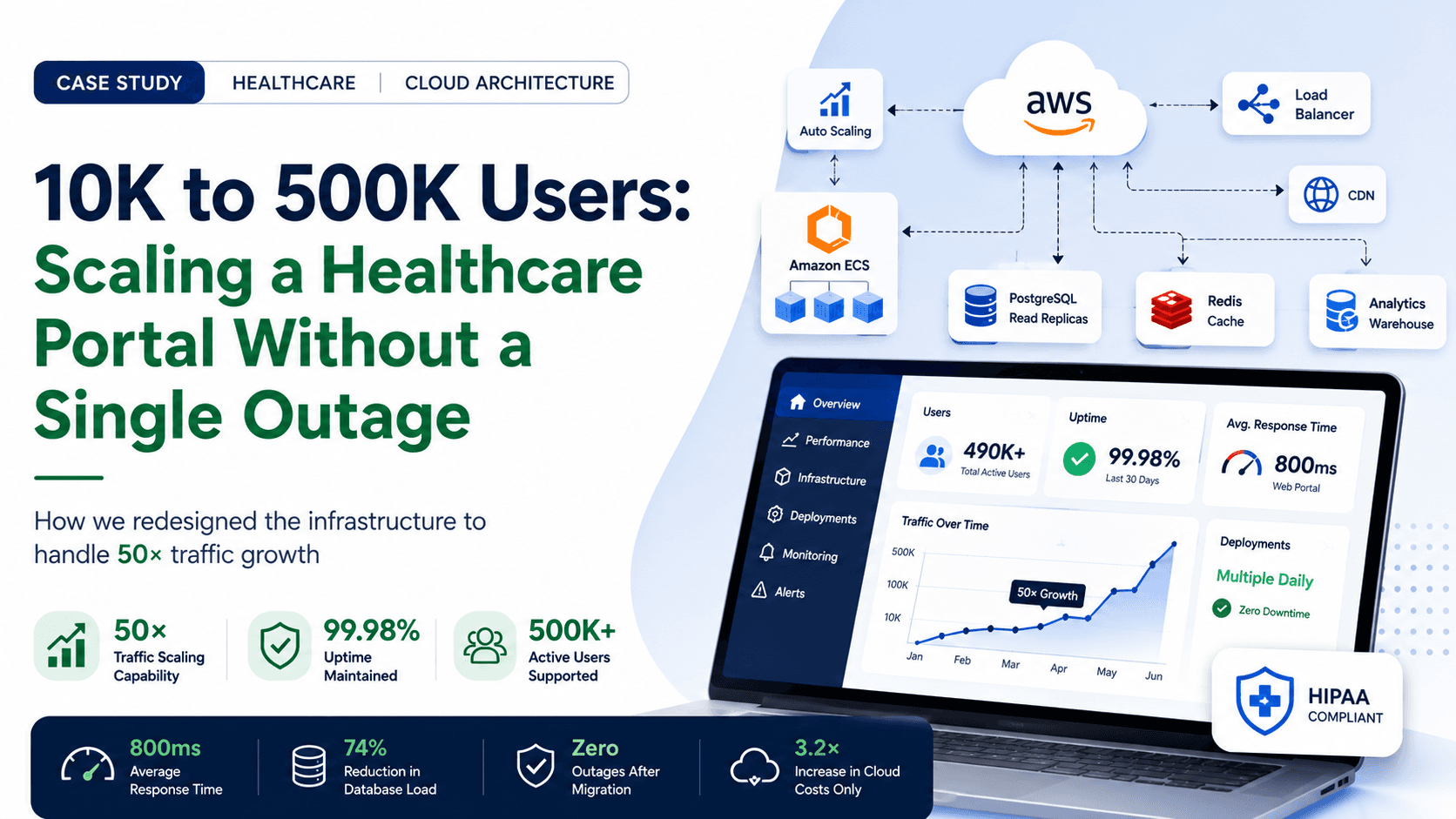
The fixed-capacity environment was replaced with an auto-scaling AWS architecture. Key upgrades included:
- containerized deployments
- ECS-based scaling
- CDN implementation
- load balancing
- automated recovery systems
3. Database and caching optimization
Pyrotrix redesigned the data layer using PostgreSQL read replicas, Redis caching, and dedicated analytics warehousing. This reduced database query pressure by 74%, while average page response times dropped from 14 seconds to under 800 milliseconds.
Architecture overview
High-level view of the scalable healthcare portal architecture delivered for this engagement.
Technology stack
| Component | Technology |
|---|---|
| Cloud provider | AWS |
| Container platform | ECS |
| Database | PostgreSQL |
| Caching | Redis |
| Monitoring | Datadog |
| Deployment strategy | Blue-Green Deployments |
The results
The insurance rollout launched on schedule. On day one alone, over 47,000 new users activated accounts. The previous infrastructure would have failed under that load. The new architecture handled the traffic without a single incident.
Impact metrics
- 800ms average response time
- 74% reduction in database load
- Zero outages after migration
Within six months:
- 490,000+ users onboarded
- uptime stabilized at 99.98%
- deployments shifted from weekly to multiple times daily
- infrastructure scaled predictably under peak demand
Despite handling 50× more traffic, cloud infrastructure costs increased by only 3.2× due to elastic scaling efficiency.
“The rollout should have been our most stressful week. Instead, we watched the dashboards stay green.”
Key takeaway
Scaling healthcare systems requires more than additional servers. It requires resilient architecture, compliance-aware infrastructure, zero-downtime deployment strategy, operational observability, and scalable data systems.
Pyrotrix transformed the platform from a fragile monolithic application into scalable healthcare infrastructure capable of supporting long-term growth without sacrificing reliability or compliance.